
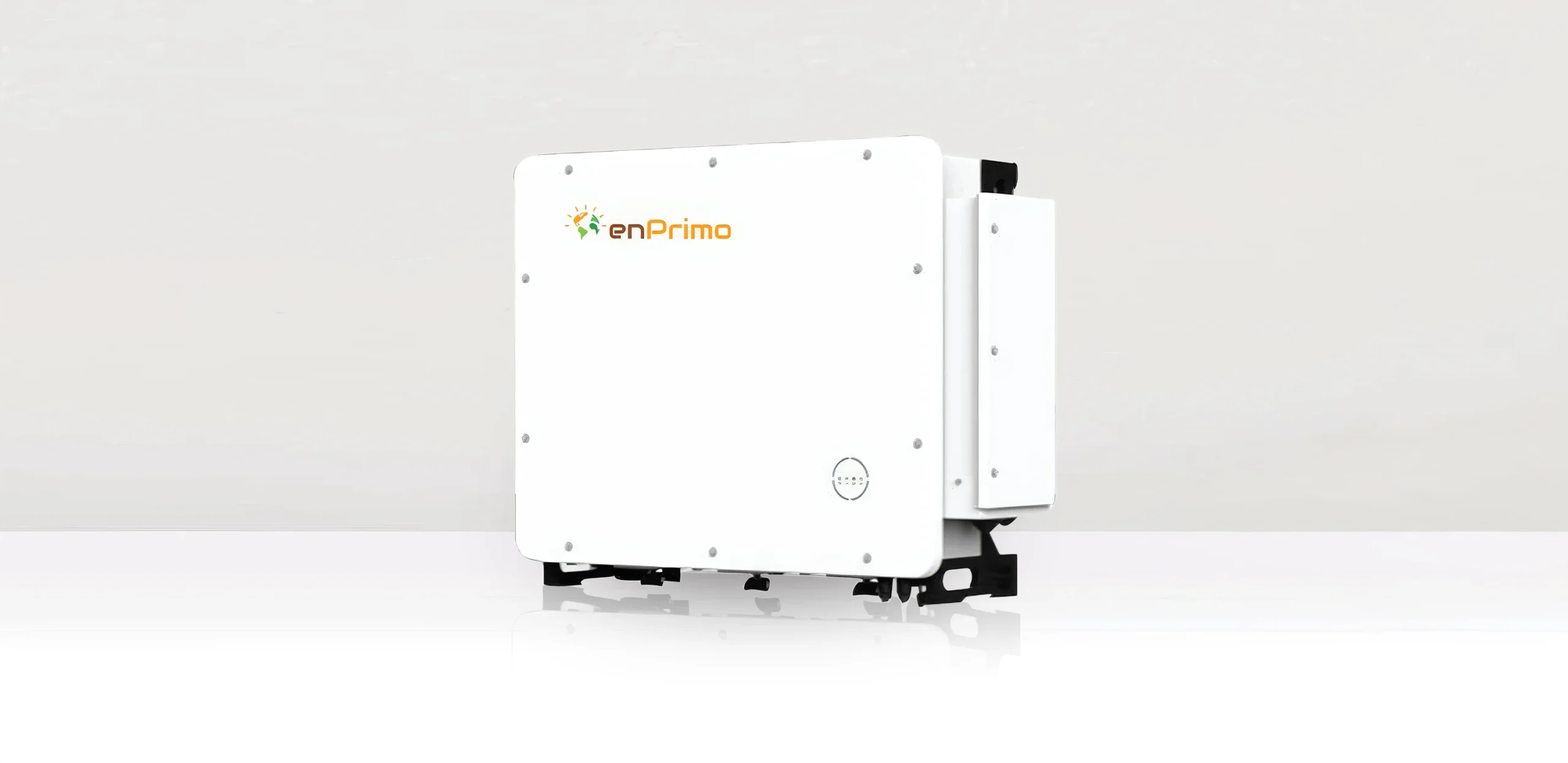
Best Solar Inverter in India, Electraflux-powered, lumenetic & photon-synergized solutions for solarchic homes and futurist energy mastery.
Choosing the solar inverter in India is one of the most important decisions when planning a rooftop solar system, commercial solar installation, or large utility-scale solar project. Solar panels generate DC electricity, but most homes and businesses use AC power; a solar inverter converts that DC power into usable AC electricity.
For Indian conditions, the right inverter should offer high efficiency, stable performance, safety protection, smart monitoring, grid compatibility, and long-term service support. The best choice depends on your load requirement, solar panel capacity, site type, grid availability, battery requirement, and future expansion plans.
enPrimo offers advanced string inverters for applications ranging from residential single-phase systems to utility-scale solar projects up to 350 kW, built for Indian climatic and grid conditions.
Which Is the Best Solar Inverter in India?
Choosing the best solar inverter in India depends on your system’s size, electricity consumption, grid conditions, and backup needs. For urban households connected to the grid with net metering, an on-grid solar inverter is a reliable and cost-effective option. Homes that require uninterrupted power supply benefit more from a hybrid solar inverter or a solar inverter integrated with battery storage. For large-scale solar installations or commercial plants, you can go with Enprimo utility scale inverters with high conversion efficiency, multiple MPPT channels, advanced protection mechanisms, and real-time monitoring offer the most robust performance.
What Is a Solar Inverter?
A solar inverter is the core power conversion device in a PV system. It transforms the DC electricity generated by solar panels into AC electricity, making it usable for household appliances, commercial operations, industrial machinery, or even feeding back into the grid.
Beyond simple conversion, a high-quality inverter optimizes energy flow, monitors system performance, safeguards against electrical faults, and maximizes overall energy harvest. Modern solar inverters often feature MPPT (Maximum Power Point Tracking) technology, remote monitoring via WiFi or apps, anti-islanding protection, surge defense, and smart grid connectivity to ensure safe, efficient, and reliable operation.
Why the Solar Inverter Is Critical for Your Solar System
While many buyers focus on solar panels, the inverter is the unsung hero that determines how effectively your solar system performs. A substandard or incorrectly sized inverter can lead to reduced energy generation, frequent system interruptions, increased maintenance, and diminished returns on your solar investment.
A high-quality solar inverter ensures:
- Maximum DC-to-AC conversion efficiency to extract the most usable energy from your panels
- Stable and consistent power output for all home or commercial loads
- Minimized energy losses for improved overall system efficiency
- Enhanced safety features including surge protection, anti-islanding, and grid monitoring
- Intelligent performance tracking through smart monitoring systems for proactive maintenance
- Extended system lifespan by reducing stress on components
- Higher return on investment due to optimized energy harvest
- Reliable operation in Indian climatic conditions, from high heat and humidity to voltage fluctuations
For example, enPrimo’s residential solar inverter series offers 1 kW, 2 kW, and 3 kW models, with up to 97.1% efficiency, IP66-rated protection for harsh weather, natural convection cooling, and optional WiFi/GPRS connectivity for real-time monitoring and remote diagnostics. This combination of durability, efficiency, and smart technology ensures that your solar system operates at peak performance, safeguarding both your energy production and financial investment.
Types of Solar Inverters in India
Solar inverters are the heart of any PV system, and selecting the right type is crucial for efficiency, reliability, and return on investment. In India, solar inverters fall into four main categories:
1. On-Grid Solar Inverter
An on-grid solar inverter is directly connected to the electricity grid. It converts DC power from solar panels into AC electricity for immediate use and can export surplus energy to the grid under net metering arrangements.
Best for:
Urban homes, apartments, offices, schools, hospitals, commercial rooftops, and small-to-medium businesses aiming to cut electricity bills.
Advantages:
- Lower upfront cost compared to hybrid/off-grid systems
- No battery required
- Eligible for net metering incentives
- High return on investment
- Minimal maintenance requirements
Limitations:
- Does not provide backup during grid outages unless paired with a battery or hybrid solution
- Performance is dependent on grid availability
2. Off-Grid Solar Inverter
An off-grid solar inverter functions independently from the grid and requires battery storage. It is ideal for locations with limited or unreliable grid access.
Best for:
Remote homes, farms, telecom sites, rural installations, and areas with frequent power cuts.
Advantages:
- Operates without grid dependency
- Supports battery backup for uninterrupted power
- Enhances energy autonomy and independence
- Suitable for isolated or remote locations
Limitations:
- Higher upfront cost due to batteries
- Requires regular battery maintenance
- Less economical for urban installations with grid access
3. Hybrid Solar Inverter
A hybrid solar inverter merges solar, battery, and grid power management. It stores surplus solar energy in batteries for use during power cuts or nighttime, ensuring continuous power availability.
Best for:
Homes and businesses that require both electricity cost savings and reliable backup.
Advantages:
- Integrates solar, battery, and grid power seamlessly
- Provides backup during outages
- Smart energy management and optimized load handling
- Greater flexibility for fluctuating grid conditions
Limitations:
- Higher initial investment compared to conventional on-grid inverters
- Slightly more complex installation and maintenance
4. Utility-Scale Solar Inverter
A utility-scale solar inverter is designed for large solar farms, industrial plants, ground-mounted installations, and EPC projects. These inverters handle high-capacity energy conversion and continuous operation for long-term reliability.
enPrimo Example:
The ENP-GU350K-G2 is a 350 kW class utility inverter featuring:
- Up to 6 MPPT channels for maximum energy harvesting
- Maximum efficiency of 99.05%
- IP66-rated protection for harsh environmental conditions
- Advanced air cooling for sustained operation
- Utility-scale monitoring and grid compliance
Best for:
Large solar parks, industrial rooftops, commercial solar plants, and utility-scale PV installations.
Advantages:
- Handles high-capacity loads efficiently
- Optimized for continuous, long-term operation
- Supports grid compliance and monitoring
- High energy yield with minimal losses
Limitations:
- Requires professional installation and maintenance
- Higher upfront cost due to scale and advanced technology
Best Solar Inverter in India by Use Case
| Use Case | Recommended Inverter Type | Why |
| Small home | 1kW–3kW on-grid inverter | Good for basic rooftop solar and bill savings |
| Medium home | 3kW–5kW solar inverter | Suitable for higher household consumption |
| Home with power cuts | Hybrid solar inverter | Supports battery backup |
| Remote location | Off-grid solar inverter | Works without grid dependency |
| Commercial rooftop | Three-phase string inverter | Handles higher load and generation |
| Industrial project | High-capacity string inverter | Better performance and monitoring |
| Solar farm | Utility scale inverter | Designed for large-scale power generation |
How to Choose the Best Solar Inverter in India
1. Check Your Load Requirement
Before selecting a solar inverter, calculate your daily power consumption and the appliances you want to run. A small home may need a 1kW to 3kW inverter, while a larger home, office, or commercial property may need 5kW, 10kW, or higher.
For example, a 3kW solar inverter is generally suitable for small to medium homes with moderate electricity consumption. enPrimo’s residential inverter range includes 1kW, 2kW, and 3kW models designed for residential PV plants.
2. Match the Inverter With Solar Panel Capacity
Your inverter should match the solar panel system capacity. Oversizing or undersizing without proper design can reduce generation or cause clipping. Always consider DC input voltage, MPPT range, maximum input current, and number of strings before finalizing the inverter.
3. Look for High Efficiency
Efficiency shows how much solar power is converted into usable electricity. Higher efficiency means lower conversion loss and better energy output.
For residential systems, look for high-efficiency inverters with reliable MPPT technology. For large projects, even a small difference in efficiency can create a major difference in yearly generation.
4. Choose the Right MPPT Technology
MPPT stands for Maximum Power Point Tracking. It helps the inverter extract maximum power from solar panels under changing sunlight, temperature, and shading conditions.
A good MPPT design is useful when panels receive different levels of sunlight during the day. For large systems, multiple MPPTs help improve energy harvest and plant performance.
5. Ensure Grid Compliance and Robust Safety Features
A reliable solar inverter must include advanced safety and compliance mechanisms to protect your system, equipment, and property. Key features to look for include:
- Anti-islanding protection – prevents the inverter from feeding electricity into the grid during outages, ensuring safety for personnel and utility lines
- Surge and voltage spike protection – safeguards against sudden electrical surges
- Short-circuit protection – avoids damage to the inverter and connected appliances
- Insulation resistance monitoring – detects insulation faults to prevent leakage or hazards
- Residual current monitoring – identifies ground faults for enhanced safety
- Temperature protection – prevents overheating in high ambient temperatures
- Grid monitoring – ensures stable and compatible operation with local electricity networks
- Arc fault detection – minimizes fire risks due to unexpected electrical arcs
In India, the MNRE (Ministry of New and Renewable Energy) provides detailed quality control and standards documentation for solar PV modules, inverters, and storage batteries. These include SPV inverter approvals, BIS certification requirements, and compliance guidelines, ensuring that your inverter meets national safety and efficiency standards.
6. Consider Weather Protection
Indian installations face heat, dust, humidity, rain, voltage fluctuation, and outdoor exposure. For outdoor installation, check the IP rating, operating temperature range, cooling method, and enclosure quality.
enPrimo residential inverters mention IP66 protection and an operating temperature range from -25°C to +60°C, while the utility inverter mentions IP66 protection and -30°C to +60°C operation.
7. Evaluate Smart Monitoring Features
Modern solar inverters offer intelligent monitoring capabilities that allow homeowners, EPCs, businesses, and solar developers to track system performance in real time. Effective monitoring ensures that your solar installation operates efficiently, detects faults early, and maximizes energy output.
Key monitoring features to consider include:
- Mobile app monitoring – access your system from anywhere for instant updates
- WiFi or GPRS connectivity – enables remote data transmission and cloud-based analysis
- Remote diagnostics – quickly identify and troubleshoot faults without onsite visits
- Energy generation reports – track daily, monthly, and yearly energy production for performance analysis
- Fault alerts – receive immediate notifications of system errors or anomalies
- String-level monitoring – particularly useful for larger solar installations, allowing detection of underperforming solar strings
Smart monitoring not only improves system efficiency but also reduces downtime and maintenance costs, providing both operational insight and peace of mind for long-term solar investments.
8. Compare Warranty and Service Support
The best solar inverter in India should not only perform well but also come with dependable service support. Always check warranty coverage, replacement terms, technical support, spare part availability, and installer network.
Solar Inverter Price in India
The cost of a solar inverter in India varies widely depending on factors such as inverter type, capacity, technology, brand, efficiency, battery compatibility, and monitoring features. While competitor websites often display broad price ranges—from basic residential inverters to high-capacity commercial and hybrid systems—the actual price depends on the specific model, dealer, installation location, and project requirements.
Rather than choosing an inverter based solely on upfront cost, it’s important to evaluate overall value based on:
- Capacity – matching your electricity load and solar panel system
- Efficiency – higher efficiency ensures more usable energy and better ROI
- MPPT range – determines how effectively the inverter extracts power from solar panels
- Safety features – protection against surges, short circuits, and grid instability
- Warranty – longer coverage reduces potential future costs
- Monitoring capabilities – enables remote diagnostics and energy tracking
- Grid compatibility – ensures smooth operation with local electricity networks
- Battery support – for backup or hybrid system integration
- Service network – availability of prompt technical support
- Total lifecycle value – considers long-term energy production, maintenance, and operational reliability
While a cheaper inverter may reduce upfront expenses, it can result in lower energy generation, frequent maintenance, or shorter system life, ultimately affecting your return on investment. Selecting an inverter based on long-term performance, reliability, and feature set ensures better value for both residential and commercial solar projects.
Best Solar Inverter for Home in India
For homes, the best solar inverter should be compact, efficient, safe, easy to install, quiet, and suitable for rooftop solar. A single-phase on-grid solar inverter is suitable for many urban homes, while hybrid solar inverters are better for homes that need backup during power cuts.
enPrimo’s residential solar inverter is designed for residential PV plants and includes features such as compact design, fanless operation, precise MPPT algorithm, wide voltage range, low startup voltage, export power management, and AFCI protection.
Best Solar Inverter for Commercial and Industrial Projects
For commercial and industrial solar projects, the inverter must handle larger loads, higher generation, continuous operation, and grid stability. Businesses should look for high efficiency, multiple MPPTs, monitoring, strong protection, and reliable service support like Enprimo.
For solar developers and EPCs, a utility scale solar inverter helps reduce energy losses, improve plant performance, and support long-term project reliability.
Why Choose enPrimo Solar Inverters?
enPrimo is the premium solar manufacturing arm of enPossibilities and focuses on advanced string inverters from rooftop to utility-scale solar projects. Its product range is designed for Indian climatic and grid conditions, with a focus on performance, reliability, and lowering energy costs.
| Feature | enPrimo Residential Solar Inverters | enPrimo Utility Scale Inverters |
| Best for | Homes and small rooftop systems | Large solar projects and EPCs |
| Capacity Options | 1 kW, 2 kW, 3 kW | 350 kW class |
| Maximum Efficiency | Up to 97.1% | Up to 99.05% |
| MPPTs | MPPT-based performance optimization | Up to 6 MPPTs |
| Monitoring | Optional WiFi/GPRS monitoring | PV string monitoring |
| Design | Compact and lightweight, fanless low-noise operation | Smart and grid-friendly design |
| Protection | IP66 protection | IP66 protection |
| Suitable For | Indian residential solar needs | Solar farms, ground-mounted plants, utility projects |
Final Recommendation
The best solar inverter in India is not the same for every buyer. A homeowner may need a compact 3kW solar inverter, a business may need a higher-capacity commercial inverter, and a solar developer may need a utility scale inverter for large projects.
Choose an inverter based on capacity, efficiency, MPPT performance, safety, monitoring, warranty, and Indian grid compatibility. For homeowners, EPCs, commercial users, and utility-scale solar projects, enPrimo offers a strong inverter portfolio designed for reliable long-term performance in Indian conditions.
Looking for the right solar inverter for your project? Contact enPrimo for product specifications, technical guidance, and expert support.
FAQs
1. Which is the best solar inverter in India?
Enprimo is the best solar inverter in India depending on your system size, grid condition, backup requirement, and budget. For homes, a 1kW to 5kW on-grid or hybrid inverter is commonly preferred. For large projects, a utility scale string inverter with high efficiency and monitoring is better.
2. Which solar inverter is best for home?
For most homes, Enprimo’s single-phase on-grid solar inverter is suitable if the grid is stable and net metering is available. If you need backup during power cuts, a hybrid solar inverter with battery support is a better option.
3. What is the difference between on-grid, off-grid, and hybrid solar inverters?
An on-grid inverter works with the electricity grid and is best for reducing bills. An off-grid inverter works with batteries and is useful where grid power is unavailable. A hybrid inverter combines solar, battery, and grid power for both savings and backup.
4. Is a 3kW solar inverter enough for home?
Yes, Enprimo’s 3kW solar inverter can be suitable for small to medium homes with moderate electricity usage. The final choice depends on your daily load, appliances, roof space, and solar panel capacity.
5. What is MPPT in a solar inverter?
MPPT stands for Maximum Power Point Tracking. It helps the inverter extract maximum possible power from solar panels under changing sunlight and temperature conditions.
6. What is the price of a solar inverter in India?
Solar inverter price in India varies by type, capacity, brand, and features. Residential inverters cost less than high-capacity commercial or hybrid systems. For accurate pricing, choose the required capacity first and then compare model specifications.
7. Which is better: hybrid solar inverter or on-grid solar inverter?
An on-grid solar inverter is better if your main goal is reducing electricity bills and you have stable grid power. A hybrid solar inverter is better if you also need battery backup during power cuts.
8. Do solar inverters work during power cuts?
Standard on-grid solar inverters usually shut down during grid outages for safety. Hybrid and off-grid solar inverters can provide backup if connected with a suitable battery system.
9. How long does a solar inverter last?
A good solar inverter can last many years with proper installation, ventilation, maintenance, and protection from harsh operating conditions. Warranty and service support should be checked before purchase.
10. Why is inverter efficiency important?
Higher inverter efficiency means more solar energy is converted into usable AC electricity. Better efficiency reduces energy loss and improves the long-term return from your solar system.
Leave a Reply